
🏛️ Poi Kalon: the Monumental Heart of Bukhara
Kalon Minaret, great mosque and Mir-i Arab Madrasa in the holy city of the Silk Road.
The architectural complex Poi Kalon —which in Uzbek literally means “at the foot of the Great”— is the monumental symbol of Bukhara. Under the shadow of the Kalon Minaret stand the great Kalon Mosque and Mir-i Arab Madrasa, forming one of the most impressive Islamic squares in all of Uzbekistan and along the ancient Silk Road.
Visiting Poi Kalon means stepping into the religious and spiritual heart of Bukhara: a place where the voices of imams, theology students and caravan travellers arriving from Samarkand, Khiva or even Persia and India still seem to echo.
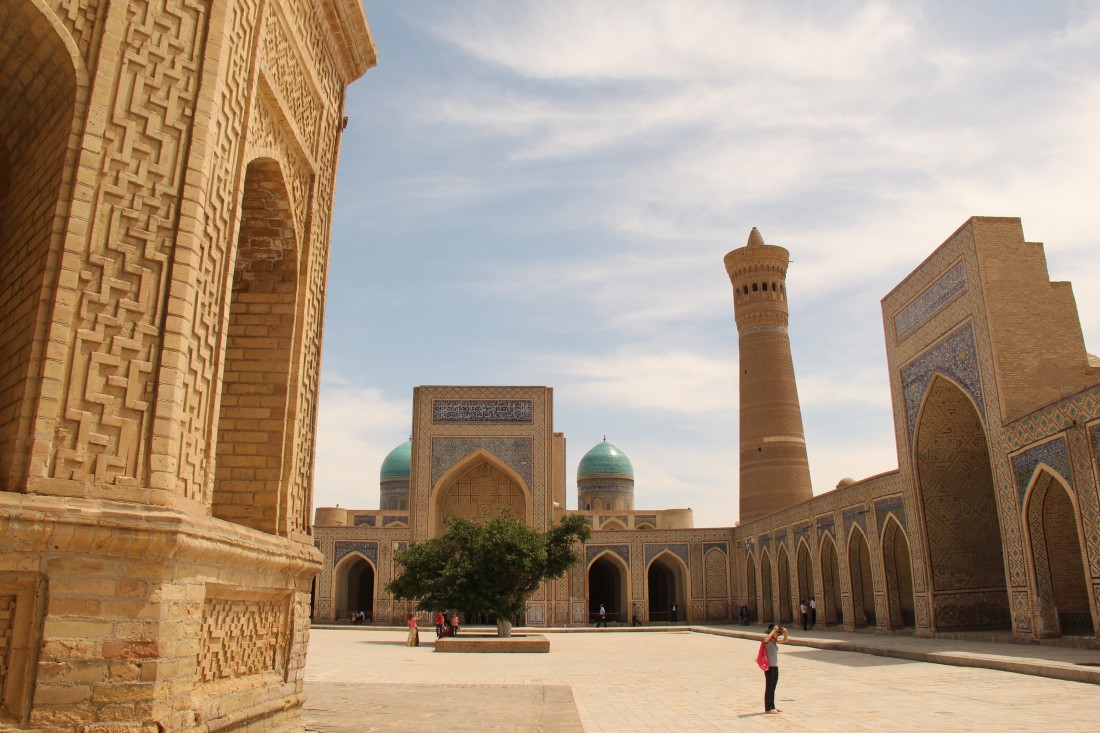
📍 What Is the Poi Kalon Complex?
The Poi Kalon architectural complex is the monumental heart of the historic centre of Bukhara, declared a UNESCO World Heritage Site. Its name, “at the foot of the Great”, refers to the powerful Kalon Minaret, which has dominated the city skyline since the 12th century.
Around this minaret a large rectangular square is laid out, where three key buildings stand:
- The Kalon Mosque, one of the largest mosques in Uzbekistan, capable of hosting thousands of worshippers during major religious festivals.
- The Kalon Minaret, built in 1127, which served as a spiritual beacon, a landmark for caravans and a symbol of power for the emirs of Bukhara.
- The Mir-i Arab Madrasa, a prestigious centre of Islamic learning that is still active today.
Standing in the centre of the Poi Kalon square, surrounded by turquoise domes and tiled facades, you quickly understand why Bukhara is considered the holy city of Central Asia.
🕌 Kalon Minaret: Lighthouse of the Silk Road
The Kalon Minaret was built in 1127 by order of the Karakhanid ruler Arslan Khan. With a height of around 46.5 metres, it became one of the tallest minarets in the region and a visual reference point for caravans travelling along the Silk Road.
It is built of baked brick and decorated with horizontal bands of geometric patterns. Inside, a spiral staircase with more than one hundred steps leads to the top gallery, where the muezzin once called the faithful to prayer.
Local legends say that at certain times it was used as a watchtower and even as a place of punishment, but today travellers remember it mostly for its panoramic views of Bukhara at sunrise and sunset. From the top you can see mud-brick rooftops, the domes of the old trading arcades and the vast courtyard of the Kalon Mosque: one of the most unforgettable scenes on any journey through Uzbekistan.
🕌 Kalon Mosque: Bukhara’s Great Sacred Square
The Kalon Mosque we see today was completed in 1514, during the rule of Ubaydullah Khan. It is the second-largest mosque in the country after Bibi-Khanum in Samarkand, and can accommodate more than 10,000 worshippers during major religious festivities.
The entrance leads into a huge central courtyard surrounded by arcaded galleries and small cells, creating a sense of calm and perfect symmetry. The main turquoise dome, together with the glazed ceramic mosaics and Qur’anic inscriptions, gives the complex a solemn atmosphere, typical of Timurid and post-Timurid architecture in Uzbekistan.
Praying, strolling or simply sitting in silence in the courtyard of the Kalon Mosque as it turns honey-gold in the evening light is one of the most spiritual experiences you can have in Bukhara.
📚 Mir-i Arab Madrasa: A Living Centre of Islamic Studies
Facing the mosque and closing the square stands the Mir-i Arab Madrasa, built between 1535 and 1536. Its main facade, decorated with turquoise tiles and geometric patterns, is one of the most photographed images in Uzbekistan.
The madrasa was founded in honour of the influential Yemeni scholar Sheikh Abdullah Yamani, known as Mir-i Arab. Generations of ulema, imams and Sufi masters were trained within its walls, which is why it is considered one of the main centres of Islamic learning in Central Asia.
Unlike other historic buildings that function only as museums, Mir-i Arab is still a working educational institution. This gives the square a special character: when you walk through Poi Kalon you are not only admiring architecture, but also feeling the continuity of religious life in Bukhara.
📸 Best Time to Visit Poi Kalon and Take Photos
Although the Poi Kalon complex is impressive at any time of day, many travellers agree that the best moments to visit are at sunrise and sunset. The golden light highlights the brick relief of the minaret and the deep blues of the domes, creating an almost unreal atmosphere.
- Early morning: the square is almost empty – perfect for photos without crowds and for enjoying the silence of the old town.
- Sunset: the surrounding streets fill with life, soft lights are switched on and the whole complex takes on a warm tone that reminds you why Bukhara is one of the most romantic places along the Silk Road.
- At night: from some angles the subtle lighting lets you take very atmospheric photos of the minaret and domes silhouetted against the dark sky.
Combining a visit to Poi Kalon with a walk around Lyabi-Hauz and the historic trading domes will give you a complete picture of historic Bukhara.
🧭 How to Include Poi Kalon in Your Trip to Uzbekistan
Most classic itineraries through Uzbekistan combine Tashkent, Samarkand and Bukhara, sometimes adding Khiva or the Kyzylkum Desert. In all of them, Poi Kalon is an essential stop.
- Access: Bukhara is connected to Tashkent and Samarkand by Afrosiyob high-speed trains, which makes logistics very easy.
- Location: Poi Kalon is in the very centre of historic Bukhara, a short walk from other landmarks such as the Ark Fortress and the Lyabi-Hauz complex.
- Recommended stay: at least 2 nights in Bukhara to see the square by day and by night, without rushing.
If you want to go deeper into the country’s history, we recommend combining this visit with other articles on our blog, such as the Top 10 places to visit in Uzbekistan or the customs and traditions of Uzbekistan. This way you will understand not only the monuments, but also the way of life that gives them meaning.
For many travellers, seeing the Kalon Minaret standing out against the sky of Bukhara is the exact moment when they fall irreversibly in love with Uzbekistan.