
🏛️ Bukhara: holy city of the Silk Road in Uzbekistan
Bukhara, also written Buxoro, is one of the most important historic cities in Uzbekistan and a key destination for cultural travel in Central Asia. Its old town, listed as a UNESCO World Heritage site, preserves madrasas, mosques, minarets, covered markets and squares where you can still feel the caravan atmosphere of the past. Together with Samarkand, Tashkent and Khiva, it forms the classic route that many travellers follow when they take a trip to Uzbekistan.
🚶♀️ 1. How to start exploring Bukhara
The perfect first walk in Bukhara is around Lyabi-Hauz, a traditional square with a central pool, centuries-old mulberry trees, tea houses (chaikhanas) and historic madrasas. It is the social heart of the old city and one of the most pleasant places to sit, sip green tea and start feeling the slow rhythm of Central Asia.
Joining a guided city tour with a local guide is highly recommended: it’s not just about “beautiful buildings”; it’s about hearing stories of caravans on the Silk Road, Sufi legends and the everyday lives of merchants and scholars.
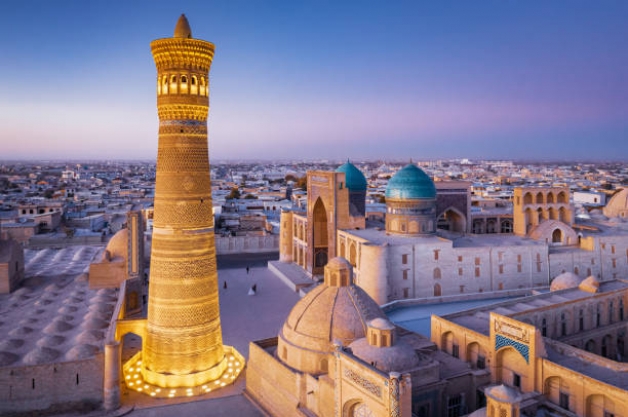
At night, Bukhara after dark is magical: golden light on domes and minarets, cobbled streets almost silent. It is a perfect time for photography and to stroll without the heat (especially useful in summer).
Many itineraries connect Bukhara with Samarkand and Tashkent by Afrosiyob high-speed train, which makes it easy to include the city even on a short trip to Uzbekistan.
📜 2. History of Bukhara: holy city & UNESCO heritage
With more than two thousand years of documented history, Bukhara was a key node in Central Asia’s caravan economy and a major Islamic religious centre. For centuries it was known as a “holy city” of the Muslim world, famous for its madrasas (Islamic schools) and Sufi spiritual life.
It was the capital of the Emirate of Bukhara until the 20th century. Theology, Islamic law, poetry and philosophy were taught here. Merchants arrived from Persia, the Turkic world and beyond, bringing silk, spices, jewellery, fine ceramics and manuscripts.
The Historic Centre of Bukhara is recognised as a UNESCO World Heritage site because it preserves the traditional urban pattern: squares around pools, covered market domes, minarets dominating the skyline, madrasas decorated with turquoise and gold tiles.
For many travellers, Bukhara is the most spiritual part of their journey across Uzbekistan, complementing the imperial splendour of Samarkand and the modern energy of Tashkent.
🏯 3. Must-see places in Bukhara
Bukhara is a living open-air museum. These are the places no cultural traveller should miss on a trip to Uzbekistan:
- Poi Kalyan complex – The religious heart of the city. It includes the great Kalyan Mosque, the Mir-i Arab Madrasa and the towering Kalyan Minaret (12th century), so impressive that even Genghis Khan spared it from destruction.
- Ark Fortress – Former fortified residence of the emirs of Bukhara. Inside you’ll see ceremonial courtyards, small museum rooms and elevated views over the historic city.
- Lyabi-Hauz – Square with a pool surrounded by madrasas and terraces. It’s the liveliest, most photogenic corner of the old town, ideal to rest and watch local life.
- Chor Minor – A small, very photogenic madrasa with four towers topped by turquoise domes. One of Bukhara’s most iconic images.
- Samanid Mausoleum – A 10th-century brick masterpiece. Considered one of the oldest and best preserved Islamic monuments in Central Asia.
- Toqi (trade domes) – Old covered bazaars where silk, spices, carpets and jewellery were traded. Even today they pulse as artisan hubs of the Silk Road.
Wandering between minarets, poolside squares and adobe alleys at sunset is one of the most memorable experiences of any trip across Uzbekistan.
🍽️ 4. Food & gastronomy in Bukhara
Eating in Bukhara is part of the journey. Local cuisine is central to the city’s identity and Uzbek hospitality. Everything revolves around shared tables, warm bread and tea.
- Plov (osh) – Rice with meat, carrot and spices, cooked in layers in a big cauldron. Each region in Uzbekistan defends its own version of plov; Bukhara’s is aromatic and hearty.
- Samsa – Pastry baked in a tandoor clay oven, filled with meat, pumpkin or slowly caramelised onion.
- Shashlik – Grilled meat skewers, served with raw onion, flat bread and sometimes grilled tomato.
- Shurpa – Traditional meat and vegetable soup, very comforting in winter.
- Green tea – Not just a drink, but a social ritual. Sitting in the shade at Lyabi-Hauz with a teapot is a 100% Bukhara moment.
If you’re into food-focused travel, step into a traditional chaikhana and just watch: local families eating together, friends chatting unhurriedly, vendors who have known each other all their lives.
🛍️ 5. Crafts & authentic souvenirs
Bukhara was a key commercial centre on the Silk Road, and that tradition is still alive in its historic bazaars. In the old trade domes (toqi) you can still find genuine local crafts:
- Decorated ceramics with floral and geometric patterns.
- Gold embroidery and traditional silk textiles.
- Hand-painted miniatures inspired by Persian and Timurid manuscripts.
- Carpets and wall hangings woven by hand.
- Ikat textiles dyed by hand, typical of Central Asia.
- Silver jewellery in Central Asian style.
Many workshops are family-run: you can watch the process, take photos, talk to the master craftsman and buy directly. It’s a responsible way to support the local economy in Uzbekistan.
Tip: haggling is part of the tradition, but always do it with respect and a smile 🙂
🌤️ 6. Climate & best time to visit Bukhara
Bukhara has a continental climate: very hot summers, cold winters and clear skies. That means golden light, long shadows at sunset and warm evenings in high season.
The best times to visit are usually:
- Spring (April–May): mild temperatures, great light for photos and lively squares and bazaars.
- Autumn (September–October): very pleasant weather, perfect to combine Bukhara with Samarkand, Khiva and Tashkent in a single itinerary across Uzbekistan.
In summer, it’s typical to rest in the middle of the day in the shade of a chaikhana with tea and dried fruit, and go out again when the sun starts to drop and facades turn honey and copper.
🧭 7. Practical tips for your trip to Bukhara
✔ Language: Uzbek and Russian are mainly spoken. In tourist areas you will find some people who speak basic English.
✔ Currency: the official currency of Uzbekistan is the Uzbek som (UZS). Carry cash for local taxis and small shops in the covered bazaars.
✔ Dress code: although Bukhara feels relaxed, remember it is a historic city with a strong Islamic tradition. To enter madrasas and mosques it’s better to cover shoulders and knees.
✔ Safety: Bukhara is considered safe for travellers. Even so, as in any popular destination, keep an eye on your belongings in crowded places.
✔ How to get there: Bukhara is connected by train with Samarkand and Tashkent. It also has an airport with regional flights.
For many travellers, Bukhara is the spiritual soul of Uzbekistan: golden minarets, quiet courtyards and a hospitality you won’t forget.