
Shahrisabz, Uzbekistan — Birthplace of Amir Timur and UNESCO World Heritage
Shahrisabz, known in Antiquity as Kesh, is one of the oldest historic cities in Central Asia, with more than 2,700 years of documented history. It lies to the south of Samarkand, less than 100 km away, and is regarded as the birthplace of Amir Timur (Tamerlane), the great conqueror who built an empire from what is now Uzbekistan.
The historic centre of Shahrisabz preserves Timurid palaces, monumental mosques, family mausoleums and madrasas decorated with turquoise tiles. Many of these structures are part of the UNESCO World Heritage and help you understand the political, military and artistic power of Timur. Visiting Shahrisabz is essential if you want to get to know the real legacy of the Silk Road in Uzbekistan beyond Bukhara and Tashkent.
In this guide you will find history, must-see monuments, local culture, handicrafts, traditional food, how to get there from Samarkand, and practical tips to organise your visit.
1. History and Timurid legacy
Shahrisabz was known in earlier times as Kesh. The city is mentioned as far back as Persian and Hellenistic periods, and later remained a strategic stop on caravan routes linking the southern mountains with Samarkand and the commercial heart of Central Asia.
The big turning point came in the 14th century with Amir Timur (Tamerlane). Timur made Shahrisabz his family city and ordered the construction of monumental complexes there to display his political and spiritual power. During that time, Shahrisabz competed directly with Samarkand for prestige: giant palaces, blue-domed mosques and mausoleums intended for him and his descendants.
Thanks to this past, the historic centre of Shahrisabz is recognised by UNESCO as part of the world’s cultural heritage. Walking along its monumental avenues literally means walking through Timur’s imperial propaganda – the man who forever shaped the history of Uzbekistan.
2. Essential monuments to visit
The most important sights in Shahrisabz can be explored on foot. They are unmissable stops if you love Timurid architecture and the Silk Road:
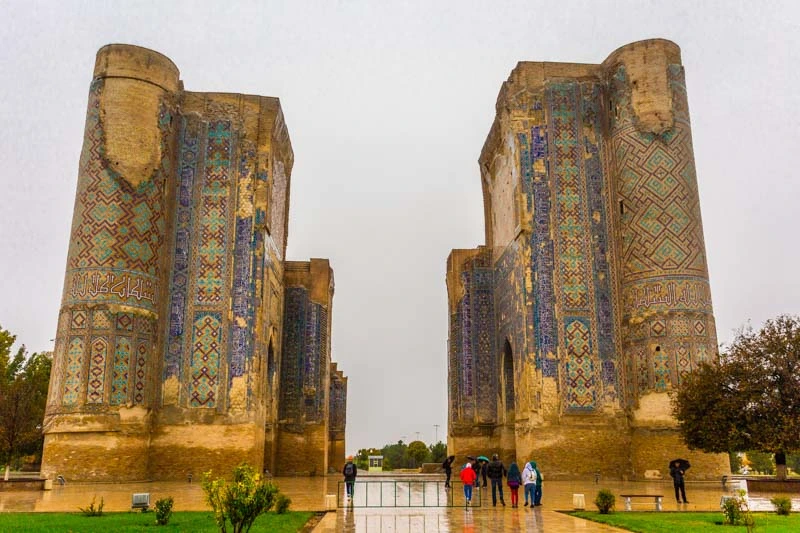
- Ak-Saray Palace (Ak Saray): Monumental residence begun by Amir Timur. Today you mainly see the huge entrance arches and some of the tile decoration, but the sheer scale is still impressive: it was a statement of power to all of Central Asia.
- Dorut Tilovat complex: Religious ensemble where homage was paid to major spiritual figures. Here you feel the blend of political authority and religious legitimacy Timur needed in order to rule.
- Kok-Gumbaz Mosque: Its name means “blue dome”. It was built by Ulugh Beg, Timur’s grandson, a famous astronomer and ruler of Samarkand. It is a perfect example of the Timurid architectural style: monumental proportions, Islamic calligraphy, turquoise ceramic tiles.
- Dor-us Siyadat complex: Family mausoleum. Here lies Jahangir, Timur’s eldest son. This place shows the intimate, human side of the conqueror: not just the iron emperor, but also the father who lost his heir.
Between monuments you will find open squares, restored gardens and pedestrian avenues designed for visitors. It is a perfect city to stroll slowly, take close-up photos (tiles, inscriptions, carved brick) and imagine what Timurid power looked like before Samarkand and Bukhara took all the tourist fame.
3. Local culture, crafts and traditions
Shahrisabz is well known for its traditional textile crafts: hand embroidery, carpets, embroidered skullcaps called tubeteika and silk work. Many families still use techniques passed down from generation to generation. Buying here means supporting local artisans, not just souvenir shops.
The area also has a winemaking tradition. The climate and fertile soil of this southern part of Uzbekistan produce aromatic grapes, and some local wineries are making wines that are gaining recognition. It is a lesser-known side of the country, far from the “only desert” stereotype.
Culturally, Shahrisabz mixes historic pride (Timur’s figure is everywhere) with a very calm everyday life: wide squares, shared green tea, straightforward hospitality. People are usually delighted to tell you that “Amir Timur was born here”.
4. Food and traditional cuisine
Food in Shahrisabz follows classic Uzbek cuisine: plov (rice with meat and carrot), hot soups with lamb and vegetables, grilled shashlik, freshly baked tandoor bread and salads with herbs.
Green tea is at the heart of hospitality. Entering a local tea house (chaykhana) and sitting on a tapchan (raised platform with carpets) is part of the experience. Eating like this – unhurried, sharing a table with locals – drops you straight into real everyday life, beyond the monuments.
Quick tip: always ask whether a dish is “spicy” or “not spicy”. In this area they can be generous with garlic, cumin and black pepper.
5. How to get there from Samarkand and other cities
The most common way to visit Shahrisabz is on a day trip from Samarkand. The road journey takes just a few hours, crossing mountain landscapes and rural villages. That is why many travellers include Shahrisabz as a “there and back in one day” stop on their Uzbekistan itinerary.
Another option is to include Shahrisabz in a longer route that links Tashkent, Samarkand, Bukhara and then heads further south. This route follows a historical logic: step by step you visit the key power centres of the Timurid era and of the Silk Road in Uzbekistan.
You can get around with a private car and local driver (very common and comfortable), shared intercity taxis, or transport organised by local agencies. If you travel as a small group or family, a private car is often very good value.
6. Practical tips for travellers
Safety: Uzbekistan in general is a calm destination. Even so, use common sense with valuables, and ask permission before taking photos of people, especially older locals or in prayer areas.
Climate: In summer it can get very hot, especially around midday, so bring water, a cap/hat and sunscreen. In winter it can be quite chilly, more than in Bukhara or Khiva, due to the mountainous area.
Cultural respect: Dress modestly when entering mosques and mausoleums. Speak softly at religious sites. And remember: the figure of Amir Timur here is not just history – it is national pride.
Do you want a full itinerary with transport and English-speaking guide for Samarkand + Shahrisabz + Bukhara? Write to us via contact and we will arrange it with trusted local agencies.