
🏺 Customs and Traditions of Uzbekistan
Cultural guide to understand the soul of the Silk Road
In the heart of Central Asia, Uzbekistan preserves an ancient culture where every gesture, melody and color tells a story. When you travel through Tashkent, Samarkand, Bukhara and Khiva, you don’t just see madrasas and minarets of the Silk Road: you also enter family homes, sit in a chaykhana, taste plov and meet real people.
This guide summarizes the main customs and traditions of Uzbekistan so that your trip goes far beyond the photos. If you understand the mahalla, green tea, weddings, Beshik-tuy or the Navruz festivities, you will enjoy every city much more – from modern Tashkent to spiritual Bukhara.
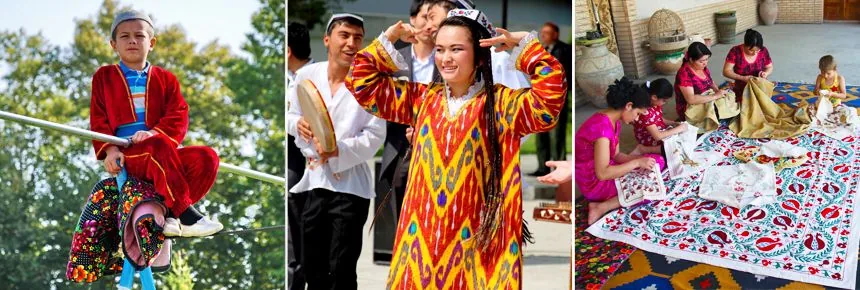
🧢 1. The do’ppi and traditional clothing
The famous do’ppi – the square embroidered cap – is one of the most recognizable symbols of Uzbekistan. You will see it in the bazaars of Tashkent, in the streets of Samarkand and in the courtyards of Bukhara. Its patterns often indicate region, age or even the social status of the wearer.
Men usually combine the do’ppi with the chapan, a quilted robe perfect for cool desert nights. Women wear silk atlas or adras dresses dyed with the ikat technique, which you will find in artisan workshops in Khiva and the Fergana Valley. More than clothing, it is a visiting card: identity, pride and everyday elegance.
Buying a do’ppi or a chapan in a traditional bazaar is one of the most authentic souvenirs of a cultural trip to Uzbekistan; at the same time, you directly support local artisans.
🐎 3. Buzkashi and equestrian games
In some rural regions, especially during Navruz or other important holidays, you may see buzkashi, a traditional nomadic equestrian game. Riders on powerful horses compete to carry a goat carcass (today sometimes replaced by a sack) to a defined goal.
More than a sport, buzqashi is a demonstration of bravery, skill and prestige within the community. Always follow your guide’s instructions and watch from a safe area: the races can be very intense.
🎶 4. Traditional music and dastans
Traditional Uzbek music is one of the best ways to understand the country’s soul. Dastans are long epic poems sung to tell stories of caravans along the Silk Road, impossible loves and legendary heroes.
They are performed with instruments such as the dutar (two-string lute), the tanbur and the ghijak, accompanied by the rhythm of the doira, a circular frame drum. In Bukhara and Khiva you can often find small concerts in historic courtyards where travelers listen to local musicians under the stars.
☕ 5. Green tea and chaykhanas: liquid hospitality
In Uzbekistan, hospitality always starts with a teapot. Green tea, sometimes flavored with herbs, is served in small handleless bowls called piyala. The host usually pours the tea three times before serving – a gesture of respect and good communication.
Chaykhanas (tea houses) are the social heart of many cities. In the Chorsu bazaar of Tashkent, in Lyabi Hauz square in Bukhara, or near the Registan in Samarkand, you will see people talking, playing and resting for hours around tea.
If you love food, you can combine these stops with our gastronomic tourism in Uzbekistan, focused on plov, samsa, shashlik and traditional sweets.
👶 6. Beshik-tuy — welcoming the newborn
Beshik-tuy is the ceremony in which the newborn is placed for the first time in a wooden cradle called beshik. Relatives, neighbors and friends gather in the family home to bless the baby, sing traditional songs and wish a long and prosperous life.
Practical gifts (blankets, clothes, diapers) and symbolic ones (embroidery, amulets, verses from the Qur’an) are offered. In this way, the new life is protected by the memory of the ancestors and the social network of the mahalla. Childhood in Uzbekistan is seen as a matter for the whole community.
✂️ 7. Hatna-tuy — spiritual coming of age
Hatna-tuy celebrates a boy’s circumcision, usually between the ages of 3 and 7. It marks an important step in his spiritual growth within the Muslim community.
The family organizes a large banquet with morning plov, homemade sweets, music and dancing. Relatives, neighbors and friends attend – another example of how family life in Uzbekistan is deeply connected to the social life of the mahalla.
💍 8. Fatiha-tuy — engagement ceremony
Before the wedding comes Fatiha-tuy, an intimate ceremony in which both families meet, exchange gifts and formalize the engagement. The Fatiha, the first sura of the Qur’an, is recited, and a table is shared, full of fruit, nuts, sweets and green tea.
It is an act of respect and honor between families. Even in modern big cities, many young couples keep this tradition as a bridge between today’s urban life and the cultural heritage of their grandparents.
👰 9. The Uzbek wedding: a festival for the whole neighborhood
Uzbek weddings can bring together hundreds of guests in large wedding halls in Tashkent or Samarkand. The decoration combines colorful fabrics, lights, flowers and, of course, tables full of food.
The religious ceremony nikah is conducted by an imam and usually takes place at home or in a separate room. Then comes the party: live music, traditional dances, modern songs, games and an endless parade of dishes. The wedding plov is the main dish and symbolizes prosperity and unity.
🍚 10. Morning plov and Uzbek gastronomy
Plov (or osh) is Uzbekistan’s national dish. Rice, meat, carrot, onion and spices are cooked in layers in a large cast-iron cauldron called qozon. Every region – from Samarkand to Bukhara – defends its own recipe.
At weddings and large celebrations, the typical dish is morning plov: it is cooked at sunrise, when the men of the neighborhood gather to cut vegetables, prepare the meat and tend the fire. Tasting plov in this way is the best way to understand the meaning of cooperation and community.
If you are passionate about food, combine your trip with our page on gastronomic tourism in Uzbekistan, where we go deeper into plov, samsa, shashlik, sweets and local markets.
🏘️ 11. The mahalla — the social heart of the country
The mahalla is much more than a neighborhood: it is the basic unit of social organization in many cities and villages of Uzbekistan. Here, support for families in need is organized, parties are planned, conflicts are resolved and decisions are made that affect the community.
Walking through a mahalla in Khiva or Bukhara means seeing children play, elders chatting on benches, women baking bread in clay ovens and young people who are connected both to tradition and modern life.
For a respectful traveler, it is the best place to observe everyday Uzbek life without filters: beyond the monuments, this is the country’s true essence.
🌸 12. How to live these traditions on your trip to Uzbekistan
The customs of Uzbekistan – from the do’ppi to morning plov, from the mahalla to huge weddings – are a mirror of the people’s soul: respect for elders, love for family, a strong sense of community and a hospitality that surprises every visitor.
At The Silk Road Travel we design cultural routes through Uzbekistan that combine the great icons of the Silk Road with local experiences: dinners with host families, visits to craft workshops, plov tastings and walks through traditional neighborhoods.
If you would like us to help you create a tailor-made itinerary through Tashkent, Samarkand, Bukhara and Khiva, write to us via the contact page. Travelling with these traditions in mind is the best way to truly connect with the people of Uzbekistan.